
Michelin and original equipment
VECTO regulations: how stricter EU emission standards are reshaping heavy-duty transport
The European Commission recently tightened VECTO regulations, increasing the responsibility of OEMs (Original Equipment Manufacturers) to help cut industry-wide carbon emissions, promoting greater transparency and introducing a new requirement for European fleets. Keep reading to find out how and when these changes will impact your fleet —and help you make more informed decisions !
SUMMARY
- Tip 1: Know why VECO exists
- Tip 2: Understand VECTO’s scope and targets
- Focus: How VECTO impacts trailers
- Tip 3: Learn how VECTO simulation calculates CO2 emissions
- Tip 4: Know the financial impact of VECTO on fleets and truck manufacturers
- Tip 5: Optimise truck tyre choices for efficiency and longevity
Tip 1: Know why VECO exists
The European Commission created VECTO to tackle CO2 emissions from heavy-duty vehicles, which contribute 6% of human-related CO2 in the European Union (1). Since 2019, OEMs (Original Equipment Manufacturers) must declare emissions for each new truck with a maximum gross vehicle weight of 16 tonnes or more. Since January 2020, it has also included light delivery vehicles with a gross vehicle weight of 7.5 tonnes or more.
As of April 2024, the rules have tightened—covering buses, trailers, and setting post-2030 targets. Toll pricing is now tied to a vehicle’s VECTO score, increasing the stakes for truck manufacturers and fleets.
These changes are expected to significantly reduce the environmental impact of road freight transport.
Keep reading to find out how and when these changes will affect your fleet and contribute to reducing its environmental impact!
Tip 2: Understand VECTO’s scope and targets
The VECTO regulation initially covered segments making up 70% of heavy vehicle emissions; now it targets 95% by including smaller sub-segments.
The first iteration of the regulation only set the target of lowering CO2 emissions by 15% by 2025 and by 30% by 2030. The new edition requires truck manufacturers to lower emissions by 45% by 2030, 65% by 2035 and ultimately 90% by 2040.(1)
Non-compliance is costly—fines range from €4,250 to €6,800 per extra gram of CO2 per tonne-km.(1) For an OEM (Original Equipment Manufacturers) registering 30,000 vehicles, one extra gram per vehicle, could result in fines of €127.5 million for just one year’s production.(2)
Focus: How VECTO impacts trailers
How will truck trailers be impacted by VECTO?
Trailer manufacturers will feel VECTO impacts immediately. With fewer levers to achieve this strict objective, compared to truck makers, tyres will be a real game changer.
VECTO calculates the combined CO2 emissions of the tractor and trailer, so optimising the trailer can reduce the combined CO2 emissions and thus lower the environmental impact of the entire vehicle configuration.
Why truck trailers?
VECTO calculates the combined CO2 emissions of the tractor and trailer, so optimising the trailer can reduce the combined CO2 emissions.
What’s the expected timeline and penalties?
Trailers registered in the European Union between July 1, 2025 and June 30, 2026 will set the baseline. Trailer makers must reach CO2 targets for trailers registered between July 1, 2029 and June 30, 2030.
Starting in 2030, trailer makers who exceed the target will be charged 4,250 € per CO2 g/t.km per trailer registered.
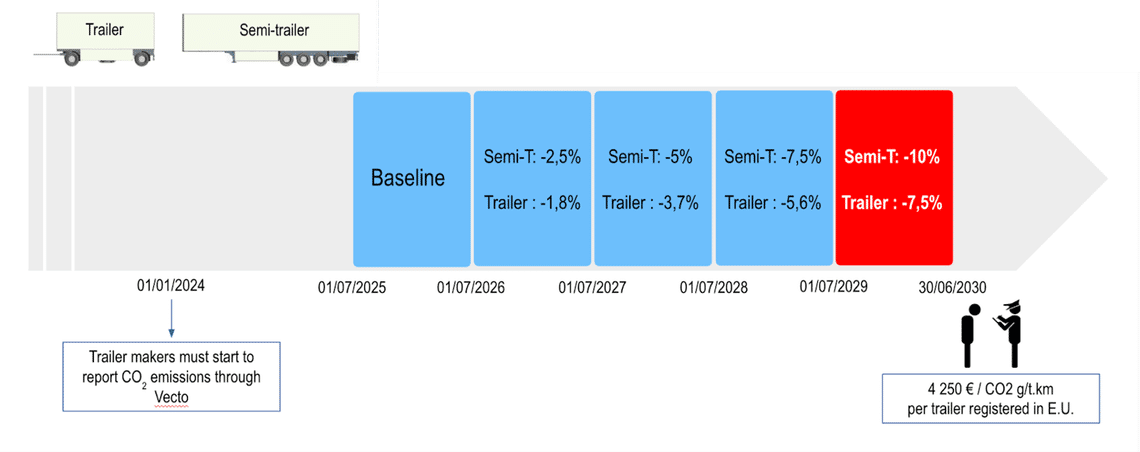
Application of vecto on truck trailers timeline
The image is a timeline illustrating the stages of CO₂ emissions reduction for trailers and semi-trailers under the VECTO regulation.
-
In the top left corner, there are illustrations of a standard trailer and a semi-trailer.
-
The timeline begins on January 1, 2024, when trailer manufacturers are required to start reporting CO₂ emissions using the VECTO tool.
-
Several key milestones follow:
-
July 1, 2025: Baseline reference
-
July 1, 2027: Semi-trailers: –2.5%, Trailers: –1.8%
-
July 1, 2028: Semi-trailers: –5%, Trailers: –3.7%
-
July 1, 2029: Semi-trailers: –7.5%, Trailers: –5.6%
-
June 30, 2030: Final targets — Semi-trailers: –10%, Trailers: –7.5%
-
-
In the bottom right corner, a note indicates the penalty: €4,250 per gram of CO₂ per tonne-kilometre for each trailer registered in the European Union.
Tip 3: Learn how VECTO simulation calculates CO2 emissions
VECTO was developed with OEM (Original Equipment Manufacturers) and academic input to ensure a uniform and fair calculation method, and to promote greater transparency in emissions reporting. It uses component-level data from five key areas: engine, tyre rolling resistance, cab aerodynamics, axle performance, and transmission efficiency.
Trucks are ranked into four CO2 classes—Class 1 being the highest emitters, Class 4 the lowest.
The European Union tracks each truck manufacturer vehicle emissions. Annual totals are calculated based on sales volume and CO2 ratings.
Did you know
OEMs (Original Equipment Manufacturers) must test each engine, tyre, cab design, axle and speed range, feeding this data into VECTO. The result is a CO2 score for every truck.
Tip 4: Know the financial impact of VECTO on fleets and truck manufacturers
Since 2019, VECTO has shaped OEM strategy. For fleets, the VECTO tool drives significant changes, particularly as regulations tie toll costs directly to a truck’s emissions class.
Germany was first to implement VECTO-based tolling, raising rates from 19 to 35 cents/km in late 2023. (3) This sharp increase created a major financial incentive for fleets to invest in lower-emission vehicles.
- A Class 3 truck driving 100,000 km/year saves €1,600 over a Class 1.(4)
- A truck’s VECTO class is fixed for six years after truck purchase, making lower-emission models a long-term financial priority
International fleets—even those based in countries where the regulation is not yet enforced—face increased costs when crossing into countries with active tolling systems.
Tip 5: Optimise truck tyre choices for efficiency and longevity
Tyres account for as much as one-third of truck's CO2 emissions (5) ౼ making tyre selection not only critical for fleet operators and truck manufacturers, but also essential to minimizing the vehicle’s environmental impact. Manufacturers are increasingly promoting low rolling resistance tyres which lower CO2 emissions, improving a truck’s overall VECTO score.
While it’s tempting to focus solely on reducing rolling resistance, Michelin emphasises the importance of equipping truck trailers with tyres that match the fleet's actual usage.
- Highway fleets benefit from tyres with an A-rating for fuel efficiency.
- Regional/construction vehicles need grip and/or robustness.
MICHELIN’s portfolio integrates technology that lowers rolling resistance and fuel consumption without compromising durability or mileage.
- MICHELIN A-rated tyres feature 12 cm of tread depth compared to the standard 9 cm. (6)
- MICHELIN X® LINE ENERGY™ tyres proven to last 30% in a DEKRA-certified study. (7)
Once figured out VECTO compliance, explore all you need to know about "Choosing truck OE tyres"
Discover more information about VECTO with our dedicated memo sheets!
FAQ: VECTO
VECTO is the abbreviation of Vehicle Energy Consumption Calculation Tool. VECTO is a computer-assisted simulation program. Designed by the European Commission, it uses a series of parameters to calculate the fuel consumption of a heavy-duty vehicle and, consequently, its carbon dioxide emissions.
Other articles that may interest you:
(1)European Commission: https://climate.ec.europa.eu/eu-action/transport/road-transport-reducing-co2-emissions-vehicles/reducing-co2-emissions-heavy-duty-vehicles_en
(2) Example of calculations of the penalties for non-compliance to the targets set up by the Regulation on CO2 emission standards for HDVs (heavy duty vehicle: lorries -with a technically permissible maximum laden mass over 3,5 tonnes-, buses, coaches) with the lowest fines of €4,250 for 30 000 HDV x 1 gCO2/tkm x 4,250€ per gCO2/tkm = 127 500 million €/year
(3) EFRET : https://www.efret.eu/news/increase-of-road-tolls-maut-and-co2-charges-for-trucks-in-germany
(4) Based on calculation - Example in Germany with the significant increase in MAUT and CO2 taxes: for 100,000 kms, based on fees of 33.2 cts/km for a Class 3 TR HGV >18T + 3-axle semi-trailer and 34.8 cts/km for a Class 1 vehicle, a Class 3 vehicle will pay 33,200€ vs 34,800€ for a Class 1 vehicle, i.e. a difference of 1,600€. https://transport.ec.europa.eu/document/download/f6ddb470-270a-4d68-947d-fdeff47380d1_en?filename=Informative%20note%20detailing%20the%20thresholds%20of%20CO2%20emission%20classes.pdf
(5) SCANIA LCA Report May 2021
(6) Michelin VECTO trailer Webinar 2024; Concretely, Michelin A-rated tyres feature 12 cm of tread depth compared to the 9 cm offered by competitors.(7) Comparative mileage study led by Michelin under the control and supervision of DEKRA (study report n° 19CPA11-129)
-
Wear life study in long haul use on routes from LEZO (Guipuzcoa-Spain) to Madrid, Valladolid, Seville and France with 12 Mercedes Actros 1851 and 1848 4x2 tractor units towing Lecitrailer tri-axle semi-trailers. Each vehicle has the same driver allocated throughout the study, speed and average fuel consumption were obtained from the vehicles' telemetry data, and the average rolling weights of the convoys were the fleet's loader data. The competitor tyres monitored were purchased on the market by DEKRA, the Michelin reference tyres were supplied by the brand. The performance of the tri-axle semi-trailer tyres was not monitored (frequent stalling). All the tyres were removed before regrooving. The mileage used for the comparison on all the axles of the tractor units was calculated from the arithmetic averages of the mileage obtained between the steering axle position and the driving axle position for each brand. The mileage of Michelin steering tyres is a linear projection to 3 mm instead of 1.6 mm, i.e. an average mileage of 301198 km instead of 362559 km.
-
With an AVERAGE MILEAGE PERFORMANCE FOR ALL POSITIONS: MICHELIN 254481 km, GOODYEAR 184646 km, CONTINENTAL 169421 km, BRIDGESTONE 166006 km, the AVERAGE GAP is 31.9% between MICHELIN & its competitors.


