EU TYRE LABEL: UNDERSTANDING TYRE LABELLING AND PERFORMANCE
The European tyre label is part of a broader European labelling system that has been gradually introduced to help consumers make informed purchasing decisions. It is applied across various product categories, such as household electrical appliances, electronic devices, and tyres.
Initially introduced in 2012, the tyre labeling regulation was strengthened with updated requirements that became applicable from 1 May 2021. This official label allows consumers to easily compare tyre performance by providing essential information on safety, energy efficiency and comfort.
What is European tyre label?
The European tyre label has been mandatory for most tyres sold in the European Union since 2012 and was strengthened by Regulation (EU) 2020/740, which came into force in May 2021.
What is the scope of application for tyre labelling?
Tyre labelling applies to new tyres for:
-
Passenger cars (C1 tyres)
-
Light commercial vehicles (C2 tyres)
-
Heavy-duty vehicles - truck, bus (C3 tyres)
Note: Off-road tyres, retread tyres are currently out of scope.
What are the objectives?
Tyre label regulation objectives are to:
-
Make consumers aware of their choices
-
Reduce fuel consumption
-
Limit CO₂ emissions of road transport
-
Promote quieter and higher-performing tyres
Tyre labelling evolution
The tyre labelling has evolved over the years for continuous improvement and to make more sense for customers. Here are the main developments:
- Reduced Rating Levels: The rating system for fuel efficiency and wet grip has shifted from 7 levels to 5 levels, ranging from A to E, making it simpler for consumers to make choices while pushing tyre manufacturer to improve the quality of their product.
- External Rolling Noise Rating: Tyres are now rated based on their external rolling noise, with a scale from A (lowest noise level) to C (highest noise level).
- Introduction of QR Codes: New labels include a QR code that can be scanned for quick access to product details and additional information.
- Snow & Ice Grip Tyre Icons: New icons to offer additional informations to the customer about winter conditions performance.
What are tyre label information displayed?
Each tyre abel is constructed around three main performance criteria (energy efficiency, wet braking, external noice), with additional optional information for certain tyres. The key elements include:
General information
The top part of the EU tyre label provides essential identification and quick access to official information:
- Tyre manfacturer: The label clearly displays the brand of the tyre, allowing consumers to immediately recognize the producer.
- Product identification: The specific tyre model is indicated to help customer to indentify the tyre concerned
- QR Code: A QR Code associated with the European EPREL database provides all information relating to labelling and a detailed information sheet that includes additional technical information on the tyre, such as its load index and speed index, and with single or twin wheels where applicable. You will also find this information sheet on all our truck tyre product pages.
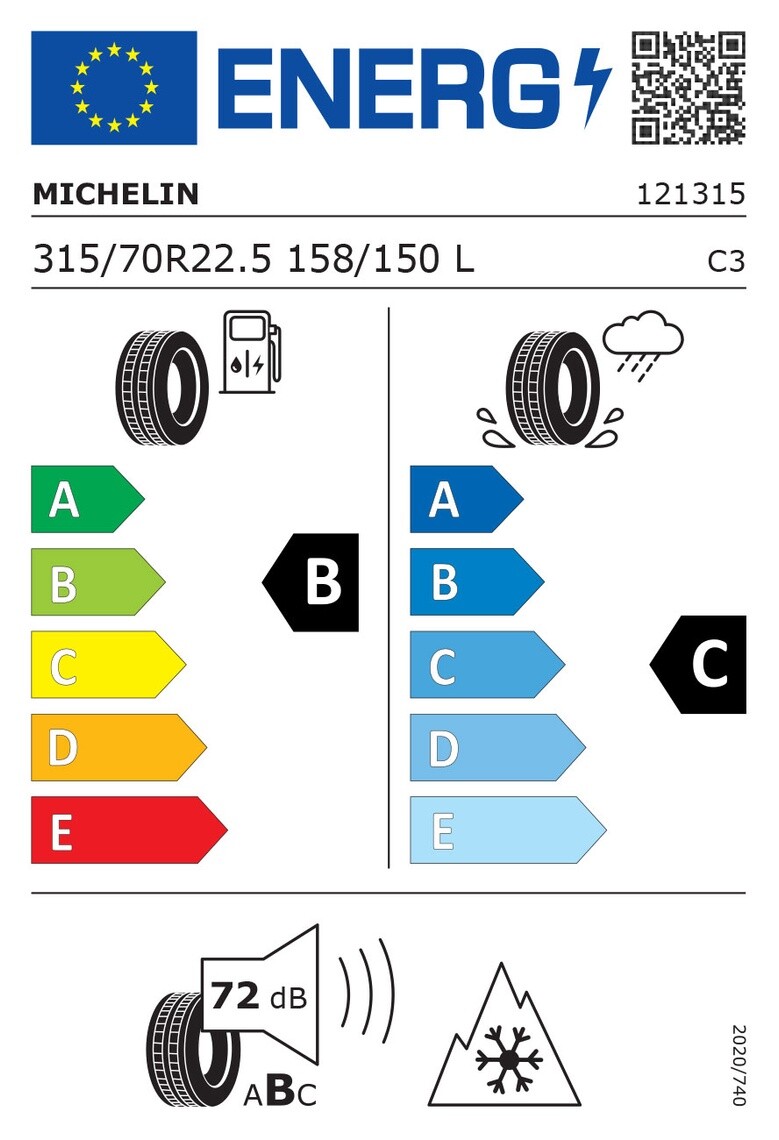
MICHELIN X Multi Energy tyre label
Performance criterias
Tyre labels classify tyres based on three standardized criteria, using uniform pictograms, precise rating scales.

pictos trans resistance
Tyre energy efficiency
This criterion measures a tyre’s rolling resistance, which directly affects fuel consumption.
Rating: from A to E
A representing the best in class
What does it mean? Tyres consume between 20 and 30% of energy. Rolling resistance varies from one tyre to another. The choice of tyre can therefore have a significant impact on a vehicle’s fuel consumption. A truck fitted with C-class tyres will consume about 0.6 litres more fuel per 100 km than a truck fitted with B-class tyres. This equates to a saving of about £690 per 100,000 km travelled (1).

pictos trans pluie
Tyre wet braking
The wet grip criterion indicates the tyre’s ability to brake effectively on wet roads.
Rating: from A to E
A representing the best in class
What does it mean? Between two classes (e.g. between classes B and C), the braking distance for a truck slowing from 60 to 20 km/h is reduced by about 3.5 metres(2).
For maximum safety, remember to keep a sufficient safety distance from the vehicle in front and regularly check your tyre pressures for better grip.

pictos trans son
External noise
The external criterion measures the noise produced by the tyre outside the vehicle, expressed in decibels (dB).
Rating: from A to C
A representing the best in class
What does it mean? The noise pollution caused by road traffic cannot be underestimated. And tyres contribute to noise pollution. Rolling noise depends as much on the type of tyres as on the road surface. The rating from one sound wave to another represents 3 dB, i.e. a 50% reduction in external noise(2).
Even if you have the best in class tyre in terms of rating, keep in mind to:
- Check regularly your tyre pressure indeed over or underinflated tyres play a significant role on your ability to make fuel savings and also on your safety (wet braking, ...).
- Fuel saving is also based on your driving style, please continue to adopt an eco-driving style, like smooth acceleration and deceleration or use of cruise control on highways when appropriate.
- The security distance must be always respected for your safety.
Additional information
Some tyres include extra information to help consumers make more informed choices. These additions, such as snow or ice grip symbols, provide technical details beyond the main ratings.
Snow tyres
The "snow condition pictogram", also known as 3PMSF (3 Peak Mountain Snowflake), identifies tyres that have been certified for use in severe snow conditions.
Ice tyres
The "ice condition pictogram" is designed for extreme winter conditions. It applies mainly to Nordic tyres, developed for very low temperatures and icy surfaces
Ice tyres are specifically designed to perform in extreme climatic conditions (icy road or road with packed snow). They may deliver reduced performance when used in milder climatic conditions (such as moderate or high temperatures), particularly in terms of wet grip, handling and wear.
Frequently Asked Questions about EU tyre label
The EU tyre label is mainly based on 3 criteria:
- Tyre energy efficiency
- Tyre wet breaking
- Tyre external noise level (dB)
The tyre label is mandatory in a defined list of European countries for new passenger car tyres (C1), light commercial vehicle tyres (C2) and heavy-duty vehicle tyres (C3).
For transparency purposes, MICHELIN voluntarily displays this label across all its European websites, including in countries where it may not be legally required.
Labels are standardized sheets that score the tyre's performance across three criteria (energy efficiency, wet breaking, external noise). Read MICHELIN dedicated article to understand the tyre labelling.
The EPREL tyre database (European Product Registry for Energy Labelling) is an official EU database where tyre manufacturers and suppliers are required to register their tyre products along with their EU tyre label information. This database promotes transparency and enables consumers to access validated data on tyre performance.
Articles that may interest you:
(1) Michelin in-house simulation carried out in January 2021 using the European Commission’s fuel savings calculator for 40% urban and 60% motorway use. Fuel price (diesel) estimated at £1.12/litre. Estimated savings per 100,000 km travelled with tyres.
(2) In-house study carried out in November 2020 in Clermont-Ferrand (France) on Michelin’s test track in Ladoux on braking from 60 to 20 km/h carried out using a 4x2 rigid truck fitted all round with 315/80R22.5 MICHELIN X® MULTITM Z B-class tyres vs. SRTT C-class test tyres, modelled on the UNECE Regulation R117 measurement protocol, updated on 23 November 2011.


