Trucks road
Make smarter tyre choices with the European tyre label

Since 2012 the European tyre label has helped fleet owners go beyond tread patterns and lifespan when choosing truck tyres by offering clear, standardised ratings for fuel efficiency, noise levels and wet grip tyre performance. Revamped in May 2021, EU tyre labelling system now makes it easier to find tyres that match your real-world needs—and starting in 2026, it also helps check your compliance with EU Taxonomy regulations.
“Choosing the right truck tyres is not always easy,” explains Ana Gonzalez, European Product Marketing Manager for Michelin’s Long Distance Transport Business Line. “It’s important for fleet owners to understand that not all criteria on the European tyre label carry the same weight for every business.” Given the impact of these factors, fleet owners need to prioritise their criteria based on their use case.
Keep reading to find the best fit for your fleet!
Tip 1: Unlock better fleet efficiency with the European tyre label
The European tyre rating system provides fleet owners with transparent, standardised information about tyre performance, focusing on three key truck tyre metrics:
Rolling resistance
pictos trans resistance
Braking on wet surfaces
pictos trans pluie
External noise
pictos trans son
Ratings are displayed on a clear scale, enabling fleet operators to make informed comparisons when selecting tyres for their vehicles.
Strong ratings across all three-boost fleet performance:
- Better wet braking improves safety
- Lower noise contributes to environmental compliance and driver comfort
- Balanced specs deliver strong overall tyre performance.
Did you know? Lower rolling resistance helps to lower fuel consumption ౼ especially important as fuel accounts for around 30% of a transport company’s cost structure(1).
helps to lower fuel consumption
Tip 2: Master the updated European tyre label rating system
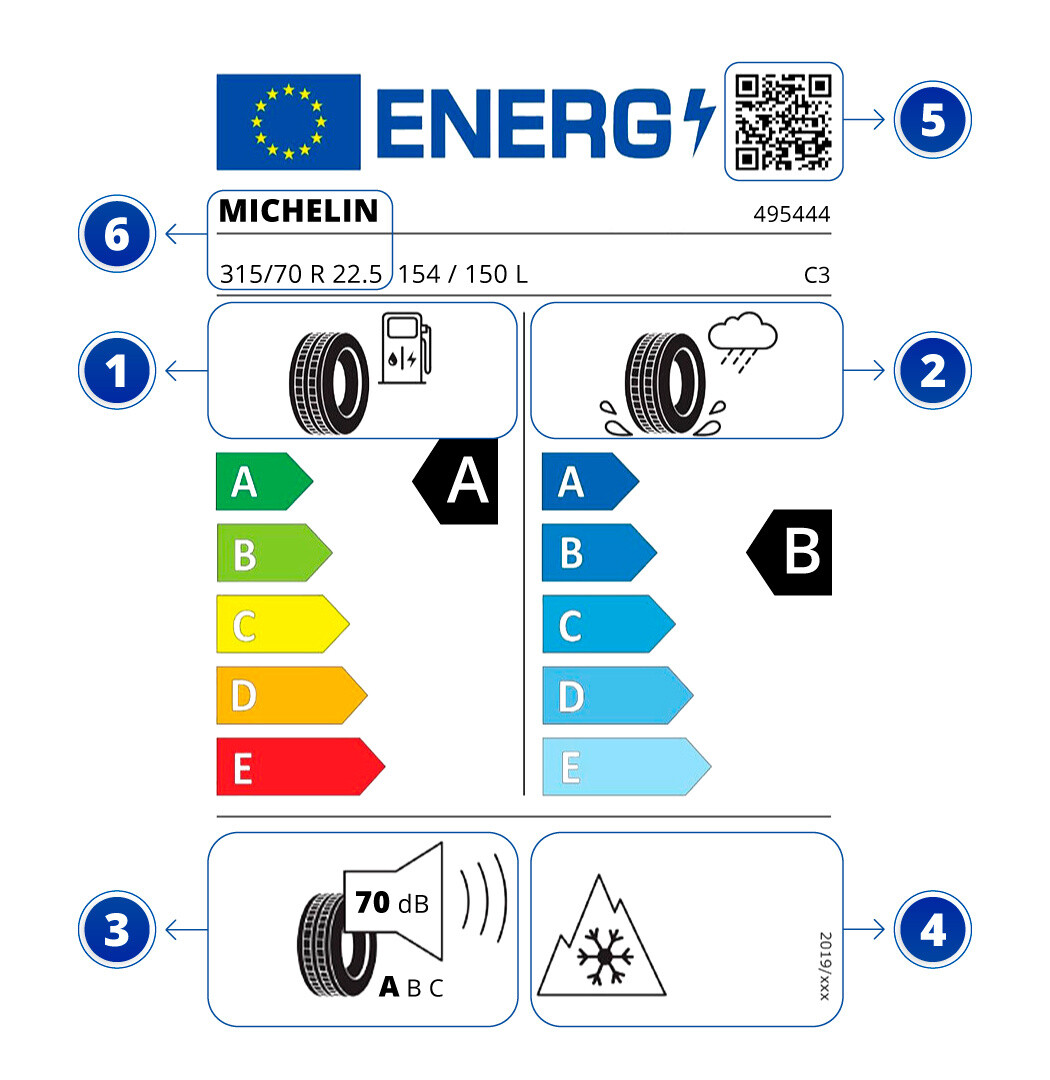
Since May 2021, the European tyre label rating system has become clearer and more informative:
etiquetage europeen v1
1. Rolling resistance: F and G classes removed, E now marks the lowest performance tier.
2. Wet braking: F and G classes removed, E now marks the lowest performance tier.
3. External noise: Now rated A - C, with precise decible levels still shown.
4. Winter tyre indicator: A new three-peak mountain snowflake (3PMSF) symbol indicates tyres that perform well in severe snow conditions.
5. A QR code links to the EU database
6. Brand and dimensions
Fleet owners can easily access the European tyre label information:
- On the truck tyre product pages of the Michelin website
- Via the new publicly available database
- In catalogues and other commercial documentation presenting Michelin’s range of truck tyres
- On e-commerce sites selling MICHELIN truck tyres online
- Printed on purchase invoices (handled by your retailers).
By providing multiple access points, the updated rating system ensures that fleet owners have all the information they need to choose truck tyres that align with their specific requirements.
The updates to the tyre labelling system reflect the European Commission’s commitment to advancing road safety, reducing CO2 emissions and minimising environmental impact.
To be aligned with the taxonomy criteria, one of the key points is that the vehicles of the fleets must have tyres that meet 2 criteria:
1. Tyre energy efficiency
Be in the two highest populated classes
pictos trans resistance
2. External noice
Be in the highest populated class (69 dB - A class)
pictos trans son
Tip 3: Prioritise complete tyre performance metrics when choosing truck tyres
Tyre energy efficiency
Tyres account for 20 to 30% of a vehicle’s energy consumption (2), and rolling resistance can vary significantly between different tyres. This variation directly impacts fuel consumption. For example, a truck equipped with C-class tyres will consume approximately 0.6 litres more fuel per 100 kilometres compared to one fitted with B-class tyres. Over a distance of 100,000 kilometres, this difference translates to a potential fuel cost saving of approximately £6903 (3).
For best results, combine with regular tyre pressure checks and training drivers in energy-efficient driving techniques.
Wet braking matters for truck tyres
The braking performance of truck tyres on wet surfaces is another critical factor affecting safety. The difference between two performance classes, such as B and C, corresponds to a reduction of approximately 3.5 metres in braking distance when decelerating from 60 to 20 km/h(4). To maintain optimal wet braking tyre performance, fleet operators proactively maintain their vehicles, ensuring that tyres are properly inflated and that sufficient safety distances are observed when driving.
Tyre Impact on Noise Pollution
Road traffic noise pollution is a significant concern, and tyres are a contributing factor. The rolling noise of tyres depends not only on their design but also on the road surface. The updated European tyre label quantifies external noise with a rating system where the difference between sound levels represented by one class, equivalent to 3 decibels (dB), signifies a 50% reduction in external noise(5).
For external noise performance, you may be interested in these tyres:
“This rating system doesn’t cover everything,” says Ana Gonzalez. “Consider tyre's mileage longevity, it's performance over time as it wears, it's potential for regrooving or retreading and even its diagonal grip. It is essential to collaborate closely with tyre specialists to define purchasing criteria tailored to the unique nature and needs of your business.” Highly efficient fleets understand and make full use the European tyre label! They also know the ins and outs of VECTO and the importance of having the right OE tyres.
Other articles to find out more:
Need more advice? Discover all MICHELIN truck tyre tips
(1) Michelin Internal. SCANIA LCA Report May 2021
(2) https://energy.ec.europa.eu/system/files/2015-02/FIN%2520User%2520guide%2520-%2520tyres_0.pdf
(3) Michelin in-house simulation carried out in January 2021 using the European Commission’s fuel savings calculator for 40% urban and 60% motorway use. Fuel price (diesel) estimated at £1.12/litre. Estimated savings per 100,000 km travelled with tyres.
(4) In-house study carried out in November 2020 in Clermont-Ferrand (France) on Michelin’s test track in Ladoux on braking from 60 to 20 km/h carried out using a 4x2 rigid truck fitted all round with 315/80R22.5 MICHELIN X® MULTITM Z B-class tyres vs. SRTT C-class test tyres, modelled on the UNECE Regulation R117 measurement protocol, updated on 23 November 2011.
(5) In-house estimate carried out by Michelin in 2016, comparing the difference in rolling noise between a truck fitted will B-class tyres and a truck fitted with C-class tyres.