Michelin and mining sustainability
Our Commitment to Help Customers Mine Responsibly
Bringing together tyres, solutions, and support designed to help mines achieve their safe, smart and sustainable goals
Michelin aims to work collaboratively with miners to develop products, services, solutions and support that are designed to help mining companies achieve their sustainability goals. We believe that together we go farther and faster. Part of our efforts include:
MICHELIN BETTER MINING
The world is facing many large-scale, urgent challenges that impact human wellbeing and environmental health – global warming, overuse of natural resources, biodiversity loss, mass migrations and poverty.
Responsible companies understand their role in building a better future.
In most instances, tomorrow’s needs mean more metals and minerals, which puts pressure on the mining industry to mine more responsibly and minimize the industry’s environmental and social impact.
For more than 30 years, the Michelin Group has been committed to reducing its environmental and social impact. That commitment extends to our role as a supplier to the mining industry.
We develop mining products, services, solutions and support for surface mines and underground mines designed to help miners achieve their safe, smart and sustainable goals. This commitment is our Michelin Better Mining approach.
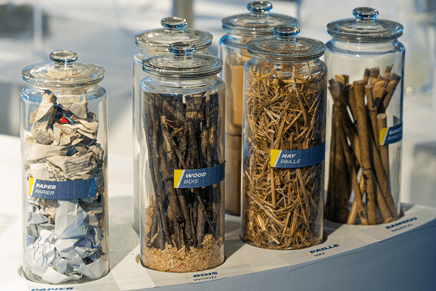
Recycled or renewable materials
Michelin Group has laid out a sizeable challenge to integrate 100% recycled or renewable materials into its tyres by 2050.
Renewable materials and recyclable materials

Renewable materials are those derived from resources that are naturally replenished on a human timescale and recycled materials are those made from feedstock recovered from industrial waste that has been reprocessed into new products, materials or substances.
This commitment lowers Michelin Group's dependence on finite raw materials and boosts its use of recycled waste to aid in a more circular economy.
Using its expertise in high-tech materials and partnership with leading global companies in recycled and renewable materials, Michelin Group is laying a roadmap to full circularity by 2050 without compromising the quality or performance of its products.
Energy-efficient mining tyres
Mining tyres can play an important role in helping mines reduce their environmental impact. Energy efficiency, including the reduction of rolling and motion resistance, and the proper use of mining tyres can help mine fleets reduce their fuel consumption and lower production costs.
Michelin has a comprehensive portfolio of products, support, services and solutions designed to help miners achieve their safe, smart and sustainably goals.
Michelin develops solutions to help mining sustainability
For example, MICHELIN MEMS 4 is an innovative tyre pressure and temperature monitoring system that is built to boost mining fleet and mining tyre performance through remote monitoring of tyre pressure and temperature and continuous tracking of tyre usage. Integrating a system like MICHELIN MEMS 4 into a site's overall production planning can enable mines to unify maintenance planning and optimize mining productivity. With this information, mines have the ability to quickly react to potential issues, decrease unscheduled downtime and extend tyre life.
Michelin Group uses Life Cycle Assessments to track and quantify the environmental impact of each stage of a tyre’s life, from “cradle to grave”, including raw materials extraction, manufacturing, finished-goods shipments, use and waste. 100% of Michelin Group's products and services will be eco-designed by 2030.
Rolling resistance and motion resistance.
How do tyres impact a mining truck’s energy efficiency and fuel consumption?
To fully understand the impact of tyres on a mining vehicle’s energy efficiency, we need to start by understanding what impedes vehicle movement. This term is called rolling resistance. In the mining industry, where mining trucks run on hard and soft surfaces, it is also important to consider motion resistance when measuring energy efficiency. Mining tyres sink into soft soil and may require even more power from the mining truck to move forward.
What’s behind these terms – rolling resistance and motion resistance – and what are the effects on a mining truck’s fuel consumption?
When a mining vehicle carries a load and operates on hard or soft ground, the tyre deforms and flexes, which generates heat. This heat represents the loss of energy, causing the mining truck to work harder to move forward. By designing mining tyres with better heat dissipation, the mining truck can exert less energy as it moves forward and consume less fuel and emits less CO2.
Read how Michelin mining uncovered opportunities to reduce a mine's CO2 emissions through a Life Cycle Assessment.
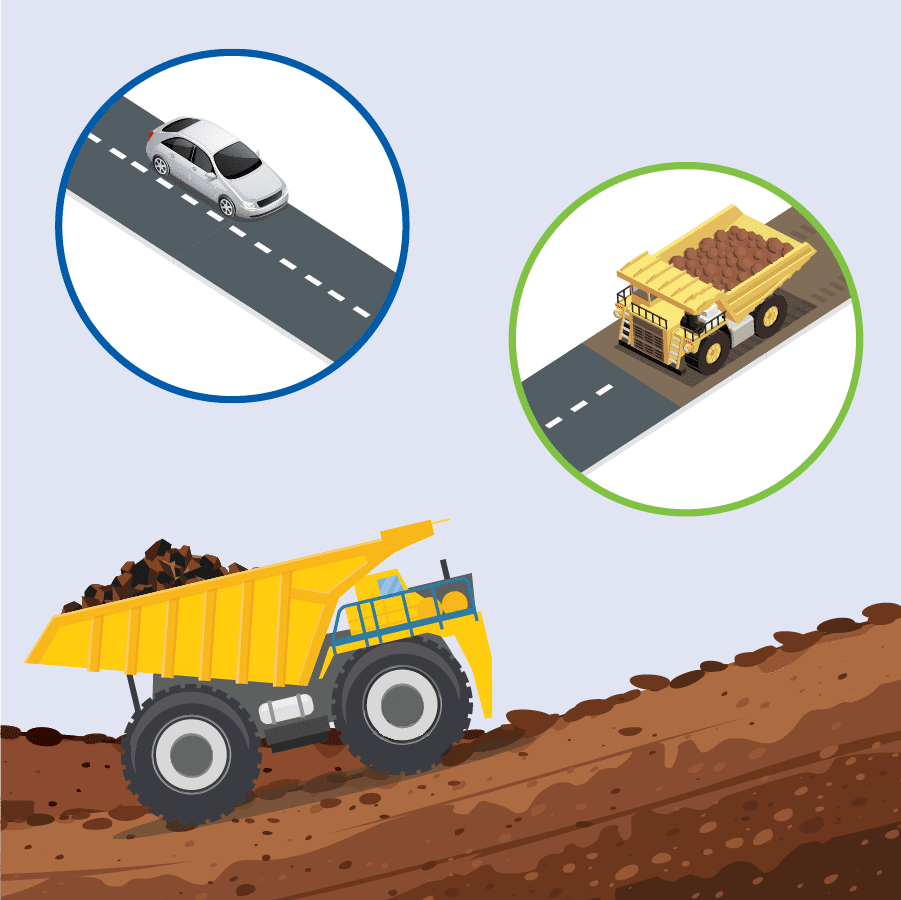
Rolling resistance and motion resistance are important factors to reduce a vehicle’s CO2 emissions
CARS
Cars run on hard surfaces: 100% rolling resistance.
Rolling Resistance and Motion Resistance are key to reduce a vehicle’s CO2 emissions and sustainable mining practices.

MINING TRUCKS
Mining trucks run on hard AND soft surfaces
On soft surfaces, tyres sink in the soil and energy is necessary to propel the truck forward. That's motion resistance, which is equally important to measure for energy efficiency.
End-of-life Mining Tyre Solutions
Michelin is working with and across the mining industry to identify agile solutions that can be adapted to local context for greater environmental and social impact. These initiatives include:
- Chile: Michelin’s First Mining Tyre Cutting and Shredding Facility
- Peru: Partnership Neuma Peru Recycling Facility
- Brazil: Managing ELTs in Brazil for more than 10 years
- Exploring partnerships in South Africa, West Africa and Australia
Life cycle assessments
Watch the video to learn about Michelin’s tyre cutting and shredding facility in Antofagasta, Chile, a milestone in Michelin’s commitment to tyre recycling.
To watch this video, you'll have to accept some cookies from Youtube platform. Just click on the button below to open the cookie module.
Accept youtube cookiesMining community wellbeing
Michelin Group has been recognized as the number one tyre manufacturer in the natural rubber industry's transparency assessment, achieving this prestigious ranking for the fourth year in a row. The recognition comes from SPOTT (Sustainability Policy Transparency Toolkit), a conservation initiative by the Zoological Society of London (ZSL), which awarded Michelin Group a score of 80.3% for its public disclosure on environmental, social, and governance (ESG) issues.
The high score reflects the Company’s ongoing commitment to transparency and accountability in the Group’s ESG practices. SPOTT uses a comprehensive framework of up to 184 ESG indicators to evaluate companies' public policies and commitments, which supports the financial sector and supply chain stakeholders in managing ESG risks.
Michelin works to support the mining community and environmentally sustainable mining.

The latest SPOTT assessment, published in March 2025, evaluated 30 natural rubber companies, including the world's largest tyre manufacturers and rubber producers. As revealed in the assessment: “Michelin is the only major tyre manufacturer to report verified evidence that plots in its supply chain are deforestation-free.”
Michelin Group was the first tyre manufacturer to adopt a public commitment in 2015 and source deforestation-free natural rubber. Today, Michelin Group is able to provide tangible proof of the deforestation-free nature of all its rubber, in line with EUDR requirements.
Michelin works to support the mining community and environmentally sustainable mining.

Responsible Mining Partnerships
Michelin Group shares many of the same ESG priorities as our customers. We aim to collaborate with and across the mining industry to identify opportunities where we can help our customers achieve their sustainability goals, including exploring engagement with organizations like the ICMM
mining sustainability with michelin
RESPONSIBLE MINING FREQUENTLY ASKED QUESTIONS
Mining is central to the global energy transition. Without mining, the world would be unable to source the precious materials that are necessary for the clean energy transition. Mining for materials such as lithium, copper, and nickel is essential for the creation of solar plants, wind farms, electric vehicle batteries, and more.
Mining is central to nearly every facet of our lives from construction to technology to mobility, and the demand for minerals and metals, especially those critical to the energy transition, is increasing.
Responsible mining is crucial to ensure the world meets the demands of today without sacrificing the needs of tomorrow.
Based on data from Life Cycle Assessments, Michelin Group knows that the greatest environmental impact of the tire occurs while the tire is in use. Maintaining proper tire pressure and temperature of mining tires can help mining trucks reduce rolling resistance, thereby consuming less fuel, emitting less CO2, and lowering the costs of the mining operations. Further, Michelin Group uses its expertise in materials and matter to understand how a tire's construction and compounds lend to greater energy efficiency. A 10% gain in rolling resistance delivers generally 1- 3% improvement in fuel consumption depending on usage.
Eco-design is a methodology for designing products and services that considers the environmental impacts from the very beginning - the design phase. Michelin Group analyzes the environmental footprint of a product or service at every stage of the life cycle based on 16 environmental factors across health, climate change, use of fossil-based resources and biodiversity. Eco-design works hand-in-hand with Life Cycle Assessments by aiming to mitigate a tire’s negative impact while preserving its qualities and performance. Michelin Group’s ambition is for all its products and solutions to be eco-designed by 2030.
Discover Michelin Mining’s comprehensive portfolio of products, services, solutions and support designed to help mines achieve their safe, smart and sustainable goals.