Earthmover machines (dumper, loader, ...) in a work site
How to choose the right earthmover tyre?
Choosing the right Michelin Earthmover tyre is essential to ensure you maximise its full performance potential. With a variety of options available, it can be challenging to make the right decision. Here are several key considerations to guide you in selecting the best earthmover tyre for your needs.
Step 1: Analyse your conditions of use and ground type
The international classification outlines four distinct categories of earthmover tyre usage, which are displayed on the tyre's sidewall as follows:
- C: Compactor
- E: Earthmoving (Transport)
- G: Grader
- L: Loader and Bulldozer
By identifying the appropriate category, users can ensure optimal performance and safety based on the specific application of the tyre.
In addition, MICHELIN provides complementary identification to some earthmover tyres:
- T: Traction
- R: Rock
- V: Speed
- F: Flotation
- P: Multi-purpose
- S/R: Smooth/Rock
For example: L3T Nomal tread depth tyre (L3 standardize code) where traction is needed (T: MICHELIN code)
Need help to read the markings? Discover our dedicated article on earthmover tyre markings.
Discover the various MICHELIN codes along with their corresponding tread patterns and applications:
CODE | TREAD PATTERN | APPLICATION | TYPE OF GROUND |
C1 | SMOOTH | COMPACTOR | LOW AGGRESSION |
E1 | RIBBED |
| LOW AGGRESSION |
E2 | TRACTION | LOW AGGRESSION | |
E3 | ROCK | MEDIUM AGGRESSION | |
E4 | ROCK (deep tread) | MEDIUM + AGGRESSION | |
E7 | FLOTATION | LOW AGGRESSION | |
G1 | RIBBED |
| LOW AGGRESSION |
G2 | TRACTION | LOW AGGRESSION | |
G3 | ROCK | MEDIUM AGGRESSION | |
G4 | ROCK (deep tread) | MEDIUM + AGGRESSION | |
G5 | ROCK (very deep tread) | HIGH AGGRESSION | |
L2 | TRACTION |
| LOW AGGRESSION |
L3 | ROCK | MEDIUM AGGRESSION | |
L4 | ROCK (deep tread) | MEDIUM + AGGRESSION | |
L5 | ROCK (very deep tread) | HIGH AGGRESSION | |
L35 | SMOOTH | HIGH AGGRESSION | |
L45 | SMOOTH (deep tread) | HIGH AGGRESSION | |
L55 | SMOOTH (very deep tread) | HIGH AGGRESSION |
There is a range of tread depths and patterns. The pattern you choose depends mainly on the terrains or road surfaces you encounter: grip, risks of cuts, rapid wear. Getting the best performance out of the machine depends to a large extent on the choice of tyre:
- Ribbed (normal tread depth)
- Traction (normal tread depth)
- Rock (normal tread depth)
- Rock (deep tread depth)
- Rock (very deep tread)
- Flotation (normal tread)
Choose the MICHELIN solution that best suits your specific environment to take advantage of all tyre performance.
Step 2: Understanding your TKPH/TMPH
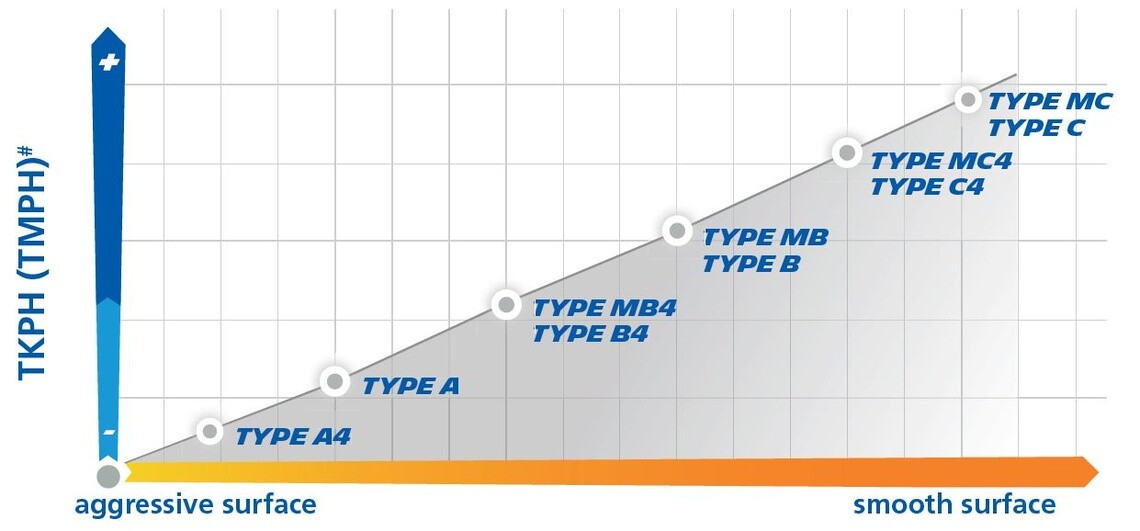
The TKPH (Tonne Kilometres per Hour) or TMPH (Tonne Miles per Hour) is an essential measure of the working capacity of your earthmover tyres.
For the same tyre size and tread pattern, there may have several types of rubber, each one associated with a different TKPH/TMPH. TKPH and TMPH values are part of the tyre characteristics. They depend on the load capacity specific to each tyre size, the number of kilometres permitted in an hour by tyre type and are given for a standardised ambient temperature of 38°C.
picto em tyre designation 3 help and advice
Types | Description | TKPH (TMPH) # | |
Aggression | A4 | Particularly resistant to cuts, tread tearing and abrasion on very rough surfaces | Minimum |
A | Particularly resistant to cuts, tread tearing and abrasion at average speeds that are higher than those for A4 (above) | Low | |
Standard | B4 | Compromise solution between abrasion resistance and average speed on rough surfaces | Moderate |
MB4 | Same as Type B4 but with a higher wear resistance | ||
B | Higher resistance to internal heat generation on surfaces that are not particularly rough | Average | |
MB | Same as Type B but with higher wear resistance | ||
Heat Resistant | C4 | Adapted to running on long cycles at high speeds on well-maintained roads | High |
MC4 | Same as Type C4 but with a higher wear resistance | ||
C | Very high resistance to high average speeds on long cycles run on well-maintained roads | Very High | |
MC | Same as Type C but with a higher wear resistance |
Step 3: Determine your earthmover tyre size
Tyre size is also an important element to guarranty compatibility and optimal performance. To find the right earthmover tyre size for your needs consider the following points:
- Diameter: Ensure that the tyre diameter is consistent with the specifications of your earthmoving equipment
- Width: Wider tyres offer improved flotation on soft terrain, while narrower tyres are typically more effective on firmer surfaces
Correct size is essential for the tyres to operate efficiently and safely within the designated operational limits of your machinery.
Find the right MICHELIN earthmover tyre for your needs
Now that you know all the steps to find the tyre that meets your needs (machine, operation environment, ...), explore MICHELIN earthmover tyres and find the one that suits you best.
Other articles to find out more:
Need more advice? Discover all MICHELIN earthmover tyre tips


