The risk of soil compaction
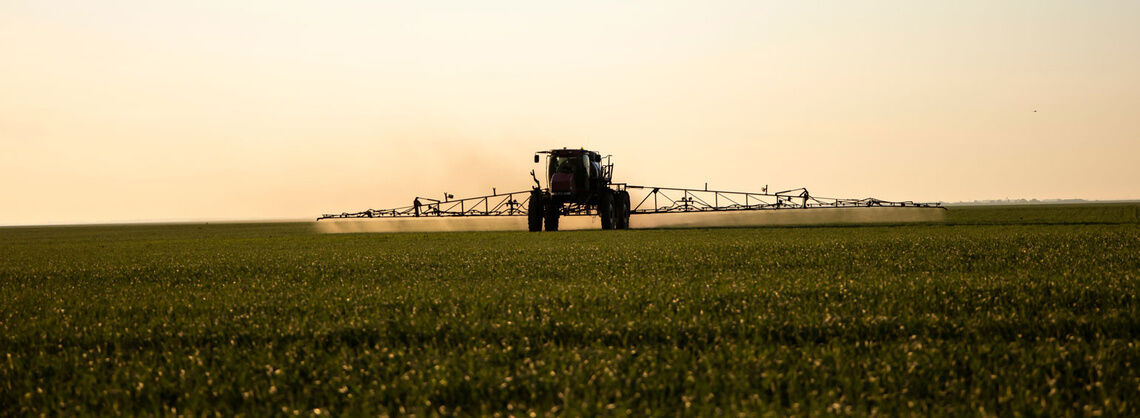
The crop treatment period can be very complicated because of the weather. It's often in wet conditions that you're going to apply crop treatments or fertiliser, which can have a major impact on soil compaction.Soil compaction arises when the soil in the field is loaded beyond its stability level when being driven on, i.e. if the pressure of the tyres on the soil is greater than the counter pressure (the counter-tension of the soil). The proportion of solid substances in the soil structure therefore increases and the proportion of pores.
The best way to limit this is to work at low pressure. In fact, it's recommended that you do this every time you work in the field, even outside the crop treatment period and even in dry conditions. When harvesting, for example, the risk of compaction is also high because the machinery used is heavier and compacts the soil.
But it's when you're working in wet conditions that the risk of compaction is increased. Fortunately, the right choice of tyre technology can reduce this phenomenon.
The difference between bias and radial tyres
Michelin invented radial technology in 1946. Why was this a major innovation? Because the principle of the radial is that the sidewalls are separated from the crown. So when you deflate a radial tyre, the sidewalls flatten out. And because the center of the tyre is separated from the sidewalls, the area of contact with the ground is extended, taking on a rectangular shape.
On a bias tyre, the crown and sidewalls are linked, which gives a domed shape. When the tyre is deflated, this affects the tread as much as the sidewalls, which means that the shape of the contact patch with the ground is elliptical and therefore smaller than on a radial.
The advantage of radial tyres is that by lowering the pressure, the tyre's footprint on the ground is longer , and as the load is spread over a larger surface area, it is less per square centimetre.
How does this longer footprint benefit you? It brings a number of expected benefits:
less soil compaction
reduced wheelslip, which means lower fuel consumption, greater productivity and less risk of soil smearing
greater comfort (the wider distribution of rubber on the ground means better shock absorption)
Do radial tyres last longer than bias tyres?
There are two aspects to tyre life: impact resistance and endurance.
A bias tyre is more resistant to impacts because it is made up of several carcasses. On the other hand, it heats up a lot when it is under heavy stress, particularly during the crop treatment phase when the tanks are heavy and the tyres narrow.
A radial tyre, which has only one carcass, deforms less and dissipates more heat, which makes it better in terms of thermal resistance. They are designed to be more durable than bias tyres, because they have a greater surface area in contact with the ground, which means that the load is distributed more evenly and consequently wears more uniformly, resulting in longer life. A bias tyre, which has an elliptical footprint, is subject to local overpressure, which tends to make it wear more quickly.
Agricultural radial tyre + Michelin UltraFlex technology = the combination you need
While the advantages of a radial tyre are undeniable, there are further benefits to be enjoyed by chosing radial tyres with Michelin Ultraflex technology.
In fact, a test has shown that between a Michelin radial tyre with Michelin Ultraflex technology and a competitor's radial tyre, the Michelin SPRAYBIB tyre has 20% more footprint *:
The footprint of a competitor's radial tyre with standard technology (dimension: 380/90 R46 172D/175A8)
The footprint of the Michelin SPRAYBIB tyre, a radial tyre of the same dimensions, designed with Michelin Ultraflex technology.
In this test*, the competitor's tyre covers 1909 cm2 whereas Michelin SPRAYBIB tyre covers 2287 cm2, which is 20% more ground surface.
In other words, when the competitor's tyre exerts a pressure of more than 27 tonnes per m2 on the ground, the Michelin SPRAYBIB tyre should normally reduce it by 4.5 tonnes per m2, which means better soil protection, better traction and fuel savings.
Of course, we have several radial tyres with Michelin Ultraflex technology, each adapted to your different machines:
The Michelin YIELDBIB tyre for tractors
The Michelin SPRAYBIB tyre for self-propelled sprayers
The Michelin FLOATXBIB tyre for self-propelled spreaders
Save fuel with adapted pressure
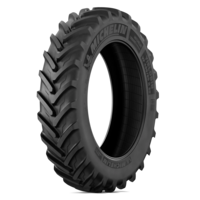
Michelin YIELDBIB
The low-pressure tyre for high-powered row crop applications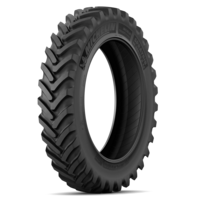
Michelin SPRAYBIB
High load capacity for sprayers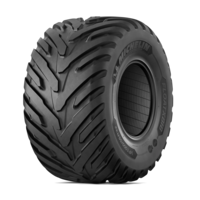
Michelin FLOATXBIB
High load capacity in the field and high speed index on roads


Other articles to find out more:
-
How to reduce your tractor's fuel consumption?
Fuel consumption can be a considerable cost to your business, especially when the price of petrol is rising. But if you can't reduce the price per litre, you may be able to reduce your fuel consumption by following our advice. In this article, we'll also highlight the tractor tyres we recommend for optimum fuel consumption.View more -
Should I use hybrid tractor tyres for roads and fields?
Is your tractor used in the fields as well as on the road? The performance you need from your tyres in these two environments is not the same. Should you equip your tractor with hybrid tyres, capable of adapting to both? Or should you opt for standard tractor tyres designed for one of the two types of terrain, to the detriment of the other? Our experts answer your questions in this article.View more -
How to reduce soil compaction and improve your crop yield?
Soil compaction causes a number of problems that can have a negative impact on your farming activity. Is it possible to reduce it? Our experts provide practical solutions that will help you improve your crop yield.View more -
Tractor tyre pressure: should you opt for automatic management (CTIS)?
We often mention tractor tyre pressure because it's crucial to your activity. When it is adjusted, it saves fuel, limits soil compaction and prevents the tyres from excessive slippage. Today, there are systems that allow you to adjust it automatically. When is it a good idea to invest in one? Our experts provide the answers.View more
* Internal Michelin study carried out in Arbonne - France in January 2022. Competitor tyres 380/90 R46 172D/175A8 and Michelin SPRAYBIB VF tyres 380/90 R46 CFO 173D/169E. The load per tyre is identical: 5200kg and the pressures used are those recommended by each manufacturer: 3.2b for the competitor tyre and 2.3b for the Michelin SPRAYBIB CFO tyre.
** CTIS is only available in certain countries. Ask your dealer for further information.