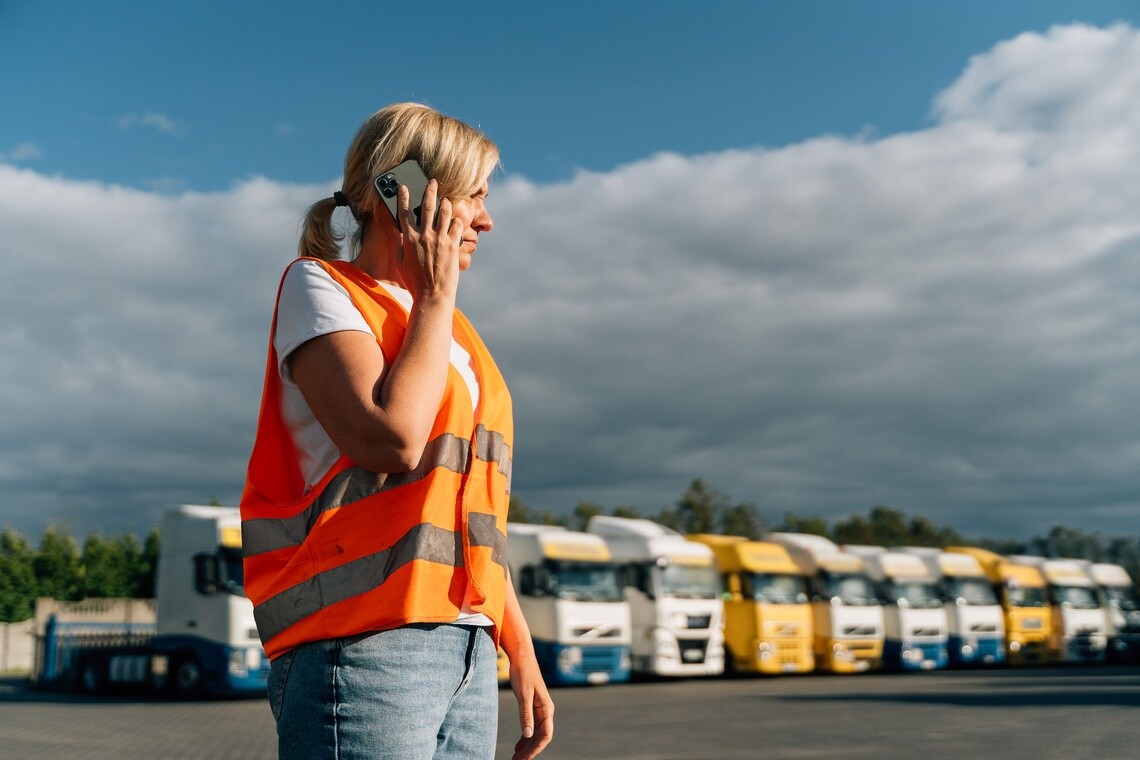
professional truck driver at a logistics hub illustrating daily operations in road transport
The world of trucking is a world of men. Or is it? We spoke with two female truckers about their work, their experiences, and their hopes for the future.
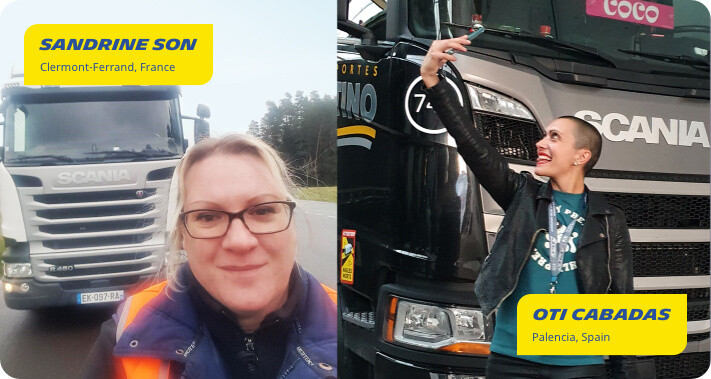
Sandrine Son is a French truck driver from Clermont-Ferrand in France – Michelin for my Business.
Across continents, throughout history, countless professions have been shaped, run and long held by men. Road haulage is one of the most striking examples. In fact, according to the International Road Transport Union1, just 4% of lorry drivers in Europe are women ౼ and in the UK, that figure drops below 2%.
Yet something is shifting. In recent years, a growing number of women have been climbing into the cab and taking the wheel. What’s behind this slow but real evolution? Shifting societal norms, perhaps ౼ or a profession that’s gradually becoming more appealing to female drivers? Maybe it’s the visibility that comes with greater media coverage, or the powerful effect of women truckers building communities on social media? To find out, we went straight to the people who know best. We spoke with two truck driving women about what their day-to-day really looks like, what drew them to life on the road ౼ and whether, despite the progress, gender biases still make the journey harder than it should be.
The open road beckoned ౼ a female truck driver’s story
For Spanish truck driver Oti Cabadas, a.k.a. Coco Trucker2, the open road lifestyle appealed to her at an early age. “I was introduced to the world of trucking by my boyfriend when I was 19 and have been hooked ever since,” she says. While she’s based in Palencia, she spends her days criss-crossing across Spain and sometimes Portugal, primarily transporting beer for her clients. When asked what she loves most about her job, it’s a quick, obvious answer: “It’s the feeling of freedom,” she says. “It’s relative freedom of course, because you always have a schedule to stick to. But you get to choose when and where you stop and to set your own itineraries. I’m very independent, so I love that.”
Several hundred miles north of Coco Trucker in the French town of Clermont-Ferrand, Sandrine Son3 echoes the same feeling. “I love my job because I feel so free on the road. Sometimes it doesn’t feel like I’m working at all,” says the French trucker. She, too, felt the pull towards the open road early on. “I grew up in the world of mechanics: my father was a technical inspector for a bus company, so I always had that idea that one day I would work on the road,” she says. “And because I love that feeling of freedom when I’m driving, I chose to work mostly nights, making deliveries for supermarkets in my refrigerated truck. At night, you’re alone on the road, there’s no congestion, no problems parking. I can just do my thing with no one bothering me.”
Not many women around ౼ the reality for women truckers
Listening to the two women truckers talk, the passion they have for their careers and that intoxicating feeling of freedom is clear as day. But we wanted to know if either of them had encountered specific obstacles for female drivers. According to Sandrine, not really. “Things have changed in recent years. Most of all, in the way we’re perceived by our male colleagues,” she says. “They sometimes stare at me a little, they’re surprised, but they don’t look down on me. All in all, I get more encouragement than condescension. There’s still some male chauvinism, sure, but it doesn’t stop me. I actually often hear male truckers saying there should be more women in the industry, for more diversity.” Increasingly, companies are beginning to echo that sentiment, recognising that recruiting more female drivers is not just a matter of fairness, but a practical response to the chronic driver shortage faced across the industry.
Coco Trucker offers a more measured take on diversity. “There are definitely more and more female truckers out there,” she says. “But it’s hard to see them on the road, because they’re still such a small percentage. When you stop for lunch, you’ll usually find yourself in a room full of men. I sometimes feel like a little ant eating on her own ౼ the only woman around.”
Female truckers on social media
With more and more women taking the leap, it’s interesting to dive deeper and discover what encourages them to make that move. For Sandrine, it might just be the power of example: “A female trucker used to be a rarity, but today, whether on TV, in magazines or on social media, they are more and more visible, and that contributes to normalising the presence of women in this industry. It shows that everyone can do it.”
A great example of the growing visibility of women truckers is the German TV programme “Trucker Babes.” Now in its twelfth season, the show follows several female truckers as they navigate their routes, find balance between life on the road and home life, and deal with the pressures that come with the job. Across the globe in Colombia, the TV series “Los Briseño” ౼ known in English as “The Road to Love” ౼ tells the story of a young woman, La Chiqui, who goes against her family’s prejudices to become a woman trucker ౼ bringing the experience of truck driving women to a whole new audience.
And we can’t overlook the power of social media in changing perspectives. Oti knows a little about that: “I’ve been sharing my experiences as a trucker on Facebook and Instagram for several years. I have quite a few followers now, but I started out by simply posting an interview I gave in a trade magazine. Then I shared things about my daily life on the road, and it caught on.” Coco Trucker also created a support group on WhatsApp, connecting with female colleagues who, over the years, have become friends. “When I started out, I didn’t know any other women, because we don’t necessarily get a chance to run into each other on the road. Thanks to social media, there are more ways to get in touch. Lots of women write to tell me they’ve always been attracted to trucking but are hesitant. I think the reason there are still so few women is because they don’t realise that they can do it. Many women don’t dare to take the leap,” she says.
One word of advice for aspiring women drivers: go for it!
“Sure, physical strength sometimes puts us at a disadvantage compared to men,” says Sandrine. “But on the other hand, we’re less abrupt in the way we drive and handle merchandise, we’re more careful. We also often have a better rapport with customers, it’s just a different style.
Research backs this up: studies consistently show that female drivers have safer records than their male counterparts, which is one reason why companies are increasingly and actively courting women in the industry.
“Also, it’s a matter of confidence more than physical abilities,” adds Oti. “I’m 1m60 tall; if I can do it, anyone can! Doing this job is all about having the vocation. If I have any advice for aspiring female truckers, I would just say: ‘follow your passion’. If driving trucks isn’t your true vocation, the job is going to be that much harder. You spend long hours on the road and you’re not home much. But if you love trucks and if this truly is your calling, I say go for it! You can do it just as well as anyone else.”
post bigstory women truckers title
To watch this video, you'll have to accept some cookies from Youtube platform. Just click on the button below to open the cookie module.
Accept youtube cookies
Before TV shows such as “Trucker Babes” in Germany and “Los Briseño” in Colombia, women truckers have been featured in a number of books and films as well. For starters, there’s the 1974 film “Trucker’s Woman” by Will Zens. A little bit of trivia: the original title “Truckin’ Man” was changed by the distributor to boost ticket sales.
Most of the time, female truckers in films are represented as fearless, no-nonsense characters. For example, viewers originally met Furiosa in “Mad Max: Fury Road” back in 2015. Several years later, the character ౼ this time played by Anya Taylor-Joy ౼ once again got behind the wheel of the War Rig in “Furiosa: A Mad Max Saga” in 2024, revealing the character’s back story. Other film references include Jill in Terry Gilliam’s cult film “Brazil” in 1985, or the two female heroes of the 1979 B-movie “Flatbed Annie & Sweetiepie: Lady Truckers.”
In 2022, Hollywood heavyweight Juliette Binoche portrayed Sally, a tough-as-nails female truck driver in “Paradise Highway.” To prepare for her role, Binoche spent a week on the road with real women truckers to ensure an accurate portrayal of the profession on the big screen ౼ signaling that, perhaps, the industry and its stories are being taken seriously.
“Most of the time, female truckers in films are represented as fearless, no-nonsense characters.”
In literature, a first-person recount of life as a woman trucker was published in 2009 by Rebby Barnard under the title “Confessions of a Female Truck Driver”, where she reflects on learning about herself and the world from the cab of her lorry. The topic of sexism is at the heart of “Silly Woman, Big Rigs are for Men” by Mary Ellen Dempsey, published in 2011. It narrates the adventures of a single mother who takes on truck driving in the 1960s to support her family. French novel “Le camion de la fille” by Louise Méheut (2020) touches upon the same subject, but in a more contemporary context, as it follows the journey of a female trucker who decides to tackle discrimination in the transportation world in court ౼ a reminder that the fight for women in the industry is far from over.
More recently, the 2021 memoir “Mothertrucker: Finding Joy in on the Loneliest Road in America,” tells the story of Joy Wiebe, the only known female ice road trucker in the United States. Written by Amy Butcher, who rode alongside Wiebe across 400 miles of Alaskan highway, the book digs deep into the reality of life on the road for female drivers and highlights the power of female friendship along the way.
To watch this video, you'll have to accept some cookies from Youtube platform. Just click on the button below to open the cookie module.
Accept youtube cookiesFAQ:
According to the International Road Transport Union4, just 4% of lorry drivers in Europe are women ౼ and in the UK, that figure drops below 2%.
There are an estimated 43–45 million truck drivers worldwide, according to the International Road Transport Union5. Women account for approximately 6% of the profession, representing around 2.5–2.7 million drivers globally.
1. https://www.iru.org/news-resources/newsroom/half-european-truck-operators-cant-expand-due-driver-shortages
2. Interview with Oti Cabadas a.k.a. Coco Trucker, on May 11, 2021.
3. Interview with Sandrine Son, on April 27, 2021.
4. https://www.iru.org/news-resources/newsroom/half-european-truck-operators-cant-expand-due-driver-shortages
5. https://www.iru.org/news-resources/newsroom/half-european-truck-operators-cant-expand-due-driver-shortages
gettyimages 930571046
car going fast on a road by night


