circular economy sustainability challenges and solutions in fleet management
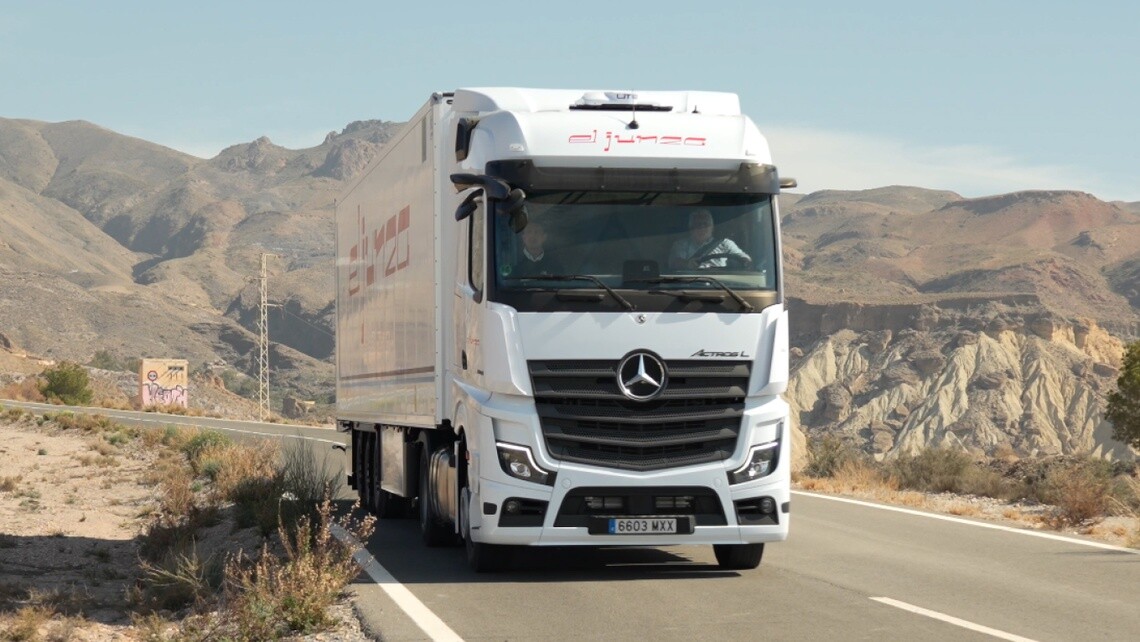
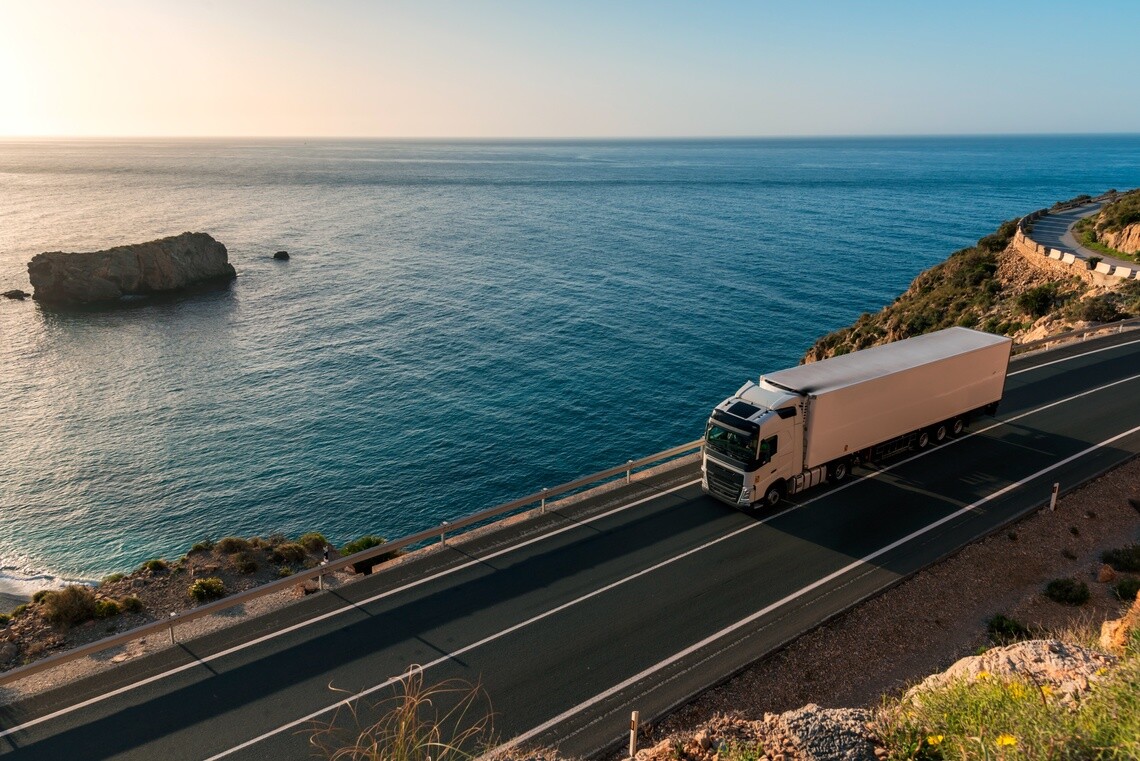
Truck with refrigerated semi-trailer driving on a road by the sea.
Sustainable fleet management and understanding your fleet’s carbon footprint remains a key topic in transport. For small and medium-sized businesses, is it feasible to align strategies around sustainability and circular economy with a fleet’s bottom line?
To get a first-hand look at the circular economy in transport we met with the team over at Transportes El Junza in Almeria, Spain to hear their strategies for reducing fuel consumption and CO2 emissions.
circular economy in transport how transportes el junza reduced their emissions
Sustainability in motion: a family fleet guided by circular economy principles
Based in Almeria, Spain, Transportes El Junza is a third-generation family-owned business of around 300 people and a fleet of around 200 vehicles. They are dedicated to international transport with a specialty in groupage which is the combination of several smaller shipments into one full container.
How joining a certified carbon reduction program can serve as a circular economy sustainability example in transport
José Pérez Aguirre, General Manager at Transportes El Junza shared with us that the future of transport will be built around fleets that know the right strategies to “reduce carbon footprints and be more sustainable.” Concrete circular economy strategies include making sure fleets are equipped with the right fuel-saving tyres as well as tapping into retreading and regrooving solutions.
Retreading: Saves 70% of the raw materials needed for a new tyre(1) and up to 115 kg of CO2 emissions.(2)
Regrooving: Saves one new tyre for every 4 regrooves and 70 kg of raw materials.(3) This can result in up to 25% more mileage and emitting 251 kg less CO2 with each regrooving.(4)
Understanding the importance of raising visibility around more sustainable strategies, Transportes EL Junza joined the Lean & Green initiative by AECOC (Association of Manufacturers and Distributors), the leading CO2 reduction program in logistics that provides fleets with verified recognition for achieving CO2 reduction targets(5).
See the real difference your actions make with our Sustainability Impact Calculator!
Reducing waste and cutting costs: the benefits of sustainable fleet management
For the team at Transportes El Junza, Michelin is the right partner to accompany them as they work towards not only reaching their CO2 reduction targets but also in reducing their overall fleet costs.
- Retreading: Costs around 40% less than an equivalent new tyre(6) and adds up to 100% more mileage(7).
Regrooving: Fuel savings of up to 5.4%(8) and a tyre lifespan of up to 25% longer.(4)
Retreading and regrooving are good practices that contribute to resource efficiency and lower emissions, representing key aspects of a broader circular economy action plan.
Use our calculators to measure the impact of your circular economy strategy on costs and sustainability
From innovative solutions to smarter strategies, the path towards sustainability and a more circular economy is clear. Solutions like retreading, which replaces the worn tread layer while preserving the tyre carcass, saves up to 70% of the raw materials needed for a new tyre.(1) Decisions like these are key to building more sustainable cities of tomorrow, in line with the aim of achieving long-term fleet efficiency.. As Transportes El Junza demonstrates, driving towards a more circular future can be beneficial for the environment AND for your business.
Recycling tyres isn’t just a goal, it’s a strategy ! See how Michelin plans to use 100% renewable and recycled materials by 2050.
To watch this video, you'll have to accept some cookies from Youtube platform. Just click on the button below to open the cookie module.
Accept youtube cookies
FAQs
The circular economy is an economic model designed to maximize the value of resources by keeping materials and products in use for as long as possible. Unlike the traditional linear model of "take, make, dispose," the circular economy emphasizes reducing waste, reusing products, recycling materials, and renewing resources.
The circular economy is a key driver of sustainability because it:
- Preserves natural resources by limiting the extraction of virgin materials.
- Reduces carbon emissions by lowering energy consumption in production.
- Minimizes waste through reuse and recycling.
- Encourages responsible innovation by designing long-lasting, repairable, and recyclable products.
Circularity is a core component of sustainability. It addresses environmental challenges like resource depletion and climate change while supporting long-term economic resilience.
Here are some key concepts of the circular economy:
- Designing products and systems from the outset to minimize waste and avoid pollution.
- Extending the lifespan of products through reuse, repair, refurbishment, remanufacturing, and recycling.
- Using renewable energy and compostable biodegradable materials.
1. In terms of material savings, the average weight of a new MICHELIN tyre is 70 kg*. The weight of a tyre ready to be retreaded weighs 50 kg** on average.
*Internal study based on the MICHELIN truck tyre sizes most sold on the European market: 315/80 R 22.5, 315/70 R 22.5 and 385/65 R 22.5. **According to a TNPF publication from 2023: “retreading, which, by reusing the casing that represents approximately 70% of a tyre’s weight” (sic). As a result, 70% of 70 kg = approximately 50 kg.
2. The CO2 impact from a retreaded tyre is linked to the material savings (See Source #1), i.e. 50 kg of raw materials saved, or 115 kg of CO2 at a rate of 2.3 kg of CO2* per kg of raw materials.
*The emissions factor of 2.3 kg of CO2 for 1 kg of tyre comes from the life cycle assessment calculations for the cradle to gate production of a tyre, conducted internally by Michelin using the calculation rules developed by the tyre manufacturing profession (via the global body, the Tire Industry Project (TIP), which brings 10 tyre manufacturers together around sustainable development themes). It includes the extraction of raw materials, transportation, and manufacturing.
3. 1 regroove means up to 25% more miles, thus 4 is up to 100% and therefore the equivalent of one new tyre saved. In terms of material savings, the average weight of a new MICHELIN tyre is 70 kg.
4. The CO2 savings from the Michelin multi-life model, are accentuated thanks to the fuel savings linked to regrooving (up to 5.4%). According to a study under real conditions of use (using 315/70 R 22.5 tyres fitted to the drive and steering axles of a 4x2 truck used for international and national long distance, that have exceeded 50% wear), the average mileage for MICHELIN X® LINE™ ENERGY™ Z2 and MICHELIN X® LINE™ ENERGY™ D2 tyres is 232,200 km before regrooving* (*Michelin internal source and calculation, based on measurements taken by the Michelin teams during customer inspections on 488 axles, (in 17 countries from 2020 to 2023), with a simulation based on the results collected suggesting extrapolation of the lifespan until 3 mm remains. The results may vary depending on the weather and road conditions. The view is that our tyres travel up to 25% further thanks to regrooving, i.e. 58,050 km (232,200 x 25%). The fuel savings are calculated over the distance travelled by the regrooved tyres (58,050 km) at an average consumption of 29.5 L/100 km for new tyres and 27.91 L/100 km for regrooved tyres (source: DEKRA report No. 21CPAEXT-030). 29.5 x 5.4%, i.e., a saving of 1.59 L/100 km for an articulated truck and tri-axle trailer (thus 12 tyres) Consequently, there is a saving of 0.13 L/100 km per tyre (1.59 L/12), i.e., 0.13 L x 58,050 km/100 = 77 litres of fuel saved when driving on regrooved tyres, thus a saving of 77 litres of diesel x 3.24 kg of CO2 = 251 kg of CO2. The emissions factor of 3.24 kg of CO2 for 1 litre of diesel comes from the life cycle assessment conducted by ADEME* for pure diesel. It includes emissions during the diesel production stages (17%) and during its combustion (83%).
*ADEME. Base Empreinte, Étude Carbone, Version 22.0.0, 02/08/2022.
5. Lean & Green
https://www.lean-green.eu/
6. Michelin internal study performed in 2022 using a European-wide competitiveness analysis tool, comparing a new MICHELIN tyre and a MICHELIN REMIX® tyre.
7. The tread compound and pattern of MICHELIN REMIX® tyres are largely the same as those used for new MICHELIN tyres. 90% of the MICHELIN REMIX® tyre range is manufactured using the same mould and the same materials as new MICHELIN tyres and therefore perform equally well. According to internal tests conducted by the Michelin Research and Technology centre and customer testimonials collected in Europe since 2015.
8. Internal study carried out at the Michelin test tracks in Ladoux (France) on 5 May 2021, under DEKRA supervision (report No. 21CPAEXT-030). For the comparison between new tyres and regrooved tyres (R5 mm), two identical Volvo FH500 trucks were used, fitted with 315/70 R 22.5 MICHELIN X® LINE™ ENERGY™ Z2 & D2 tyres and each towing a fully loaded (40 tonnes) Schmitz Cargobull trailer fitted with 385/55 R 22.5 MICHELIN X® LINE™ ENERGY™ T tyres at identical pressures (8.5 b, 7.5 b and 9.0 b). Results may vary depending on weather conditions, road type, tyre size and driving style.
gettyimages 930571046
car going fast on a road by night