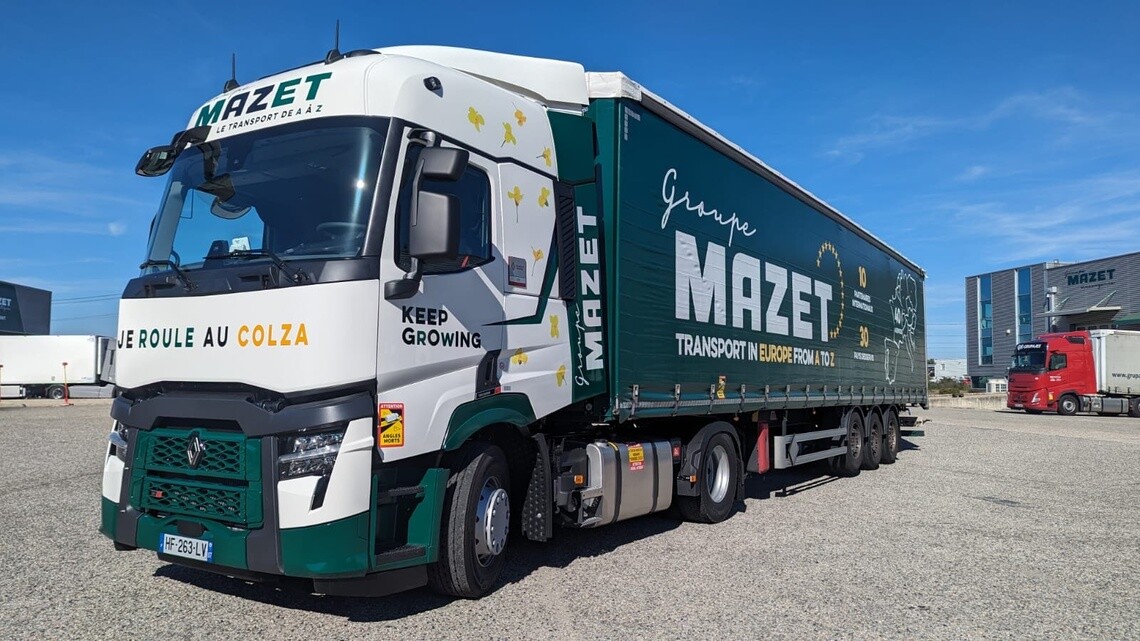
Transport Mazet biodiesel truck showcasing sustainable transport solutions.
For more than a century, Transport Mazet has been on the move ౼ evolving, expanding, and adapting to the concerns and needs of a changing world. Founded as a family business, the group now manages the full transport supply chain, from domestic and international delivery to freight forwarding, warehousing, and order preparation. Over the decades, it has grown steadily into a network of 40 sites across France, employing 1,000 people and operating 1,000 registered vehicles: 550 articulated trucks, light commercial vehicles and rigid trucks, with 70% of them powered by rapeseed biodiesel, and 450 semi-trailers.
That enduring success rests on one constant: the ability to evolve with the market. Today, that evolution means embracing environmental responsibility as a driver of performance and trust.

01 pierre louis mazet president of groupe mazet who leads the company s transition to sustainable transport and biodiesel
Pierre-Louis Mazet, President of Groupe Mazet.
A holistic approach to decarbonisation
Under the leadership of Pierre-Louis Mazet, President of Transport Mazet, sustainability has become central to the company’s strategy. And as a fourth-generation transporter himself, he is acutely aware of the impact the industry has on the planet: heavy-duty vehicles account for more than a quarter of road transport greenhouse gas emissions and about 6% of total EU greenhouse gas emissions1.
As Pierre-Louis Mazet points out, Transport Mazet’s response to this climate urgency is a “comprehensive, gradual and highly committed approach”, addressing every dimension of its operations. Beyond vehicles and fuels, the company is:
- • Harnessing solar power through photovoltaic panels on its sites
- • Designing energy self-sufficient buildings
- • Reducing consumption of electricity, materials, and consumables
- • Promoting eco-driving through communication and training
Biodiesel advantages: a concrete step towards cleaner transport
Among Transport Mazet’s key initiatives, one action that stands out for its immediate and measurable impact: the transition to biodiesel trucks to tackle environmental concerns. After considering other alternative energy sources, including electrification and hydrogen, Transport Mazet decided to switch to B100 bio fuel. “We felt a global responsibility to act,” says Pierre-Louis Mazet, underlining the use of biodiesel as part of this commitment. “Our clients also expect their partners to take virtuous steps to reduce carbon impact, and as suppliers, it’s our duty to meet those expectations.”
Since 2019, Transport Mazet has powered its vehicles with B100 bio fuel produced by Oleo100, derived from French-grown rapeseed oil and entirely made in France. This biodiesel production process cuts emissions, supports local agriculture, and strengthens the domestic value chain.
While the shift involves some operational adjustments ౼ a slightly higher vehicle purchase price and marginally increased fuel consumption ౼ the cost of B100 is comparable to diesel, and the benefits are substantial. The company has achieved a 60% reduction in well-to-wheel carbon dioxide (CO₂) emissions, eliminating 5,000 tonnes of CO₂ in 2024 alone ౼ equivalent to 2,900 round-trip flights between Paris and New York.2
To watch this video, you'll have to accept some cookies from Youtube platform. Just click on the button below to open the cookie module.
Accept youtube cookiesPartnerships powering Transport Mazet’s bio fuel transition
Behind every transformation lies the strength of collaboration to address shared concerns. Working closely with Oleo100, Transport Mazet has installed dedicated biodiesel solutions across all sites, ensuring fuel autonomy and seamless operations. The compatibility of B100 with Renault biodiesel trucks has minimised the need for new training or major mechanical adaptations.
“When it comes to reducing our carbon footprint, the vehicle component is the most significant,” says Pierre-Louis Mazet. “Thanks to our partner Oleo100, we’ve been able to measure the impact of our shift to bio fuel.”
Decarbonisation doesn’t stop at the use of biodiesel. For Transport Mazet, sustainability also involves operational efficiency and resource management ౼ areas where Michelin tyres play a key role. Michelin’s tyre ranges help reduce fuel consumption, extend tyre life through regrooving, and minimise raw-material use through retreading, supporting Mazet Transport’s circular strategy.
This partnership-based approach not only accelerated Transport Mazet’s low-carbon transition but also helped the company qualify for new tenders and attract sustainability-minded clients, proving that environmental responsibility can be a real business advantage.
Eco-driving: Combining safety, efficiency, and responsibility
For Transport Mazet, true sustainability also depends on how every kilometre is driven. Eco-driving has become a cornerstone of the company’s environmental culture.
Led by three trainers across France, the programme empowers every driver to improve through training every five years and monthly performance reviews. Each vehicle is equipped with an Fleet Management System port recording key metrics ౼ acceleration, braking, idling, and coasting ౼ which trainers analyse in real time to offer personalised advice. “I also work with drivers on their trajectories to reduce tyre wear and extend vehicle longevity,” says Alban Aumage, head of Transport Mazet’s eco-driving program.
“My goal isn’t to act like a traffic officer - I’m here to guide, support, and empower our drivers.”
This combination of technology, analysis, and human engagement yields measurable results, as Alban Aumage testifies: “Every year, we manage to lower our consumption by about 1 liter/100Km thanks to the technical advances on our vehicles and driver training.”
To watch this video, you'll have to accept some cookies from Youtube platform. Just click on the button below to open the cookie module.
Accept youtube cookiesFleet and tire monitoring, key pillars of the low‑carbon strategy
Fleet maintenance is managed by PLA (Poids Lourds Albenassiens) technical centres, in close partnership with Michelin and Euromaster. Euromaster provides daily monitoring and technical support, while Michelin supports fleet analysis and strategic optimisation, with the aim of improving transport operators’ total cost of ownership while reducing environmental impact.
Romain Lacoste, Director of the PLA, explains it clearly: ‘the choice of tires is essential when it comes to fuel consumption: to reduce it, Michelin offers an energy‑efficient range. For example, for the freeway range, we can take an X® LINE ENERGY™ profile which has low rolling resistance, which allows us to make savings in fuel consumption and CO2 savings.” For more regional routes, he favors the X® Multi Energy range.
To watch this video, you'll have to accept some cookies from Youtube platform. Just click on the button below to open the cookie module.
Accept youtube cookiesRomain Lacoste also highlights the importance of regrooving in managing the tire portfolio: “So you have to monitor the tires carefully to regroove them at the right time so as to really benefit from the last few millimeters of rubber and make the greatest possible fuel savings.” He also reminds us that “We estimate that regrooving gives us roughly 25% more mileage3.”
In this sustainable approach combined with effective total cost of ownership management, Romain Lacoste concludes by emphasizing the obvious benefit of retreading tires: “It delivers a significant cost saving and a significant reduction in raw material consumption.’”
Moving forward: progress built on trust
“The impact of this transition has been very positive — both for our clients, who appreciate our proactive stance, and internally, where it has brought a sense of renewal and modernity to our fleet and our corporate image,” says Pierre-Louis Mazet. “It also helps us attract new talent, showcasing Mazet as an engaged, forward-looking company that takes pride in its ecological transition.”
As Mazet continues to advance its sustainability journey, the company stands as proof that responsibility and performance go hand in hand. The shift to biodiesel trucks, eco-driving initiatives, and partnerships with trusted innovators are not endpoints — they’re milestones on a path of continuous improvement.
As for those ready to begin their own transition, Pierre-Louis Mazet offers a clear message: “Analyse your real needs. Focus on actions with real impact. And move step by step, seeking help and guidance from trusted partners who can support you on the journey toward lasting progress.”
FAQ :
Biodiesel can significantly reduce well-to-wheel carbon dioxide (CO₂) emissions in biodiesel trucks. Transport Mazet cut its emissions by 60% using B100 biofuel.
Yes! Most modern diesel engines can operate on biodiesel blends, while dedicated biodiesel trucks such as Transport Mazet’s Renault B100 fleet run entirely on biodiesel with minimal mechanical adjustments.
The distribution infrastructure can limit broader adoption; however partnerships like Transport Mazet’s with Oleo 100 show how the local production of biodiesel can help overcome these barriers.
The production of biodiesel involves vegetable oils, used cooking oils, or animal fats, alcohol and a catalyst. Transport Mazet’s supplier Oleo100 uses 100% French-grown rapeseed oil to produce its B100 biofuel.
2. Internal calculations and data within the Groupe Mazet
3. +25% more mileage thanks to regrooving: compared with a worn MICHELIN tyre that has not been regrooved. For an average regrooving depth of 4 mm. Information based on TNPF recommendations from 2013, explaining that regrooving can, when the tyre reaches its wear limit, increase the tyre’s longevity by using all the available rubber.

gettyimages 930571046
car going fast on a road by night